Stand in a British woodland in February and nearly every conifer you meet will still be wearing its needles. The larch will not. It is a conifer that behaves, in one important way, like an oak or a birch: it sheds its foliage in autumn and stands bare until spring. That single habit makes larch easy to spot in winter, and once you know what else to look at, straightforward to confirm in every other season.
Larch is widespread across Britain, planted in forestry blocks, shelterbelts, parkland and on hillsides. Three sorts turn up most often: European larch, Japanese larch and the Dunkeld larch, a hybrid of the two. You do not need to tell those apart to identify a larch. You need four things: needles, cones, bark and the tree's colour through the year.
The one thing that sets larch apart
Larch is deciduous. It is the most widespread deciduous conifer in Britain, which sounds like a contradiction until you see it happen. In high summer a larch can pass for any other conifer from a distance; by December it can look, to an untrained eye, like a dead tree. The giveaway is in the twigs. They stay thin and knobbly rather than smooth, and the small brown cones frequently stay attached through the winter.
Once you have that in your head, everything else falls into place.
Needles: soft, clustered and gone by November
Larch needles are short — roughly 2–4cm — soft to the touch and a fresh, light green. They are far gentler on the hand than spruce, which pricks, or pine, which feels coarse and waxy.
Unlike pine needles, which arrive in bundles of two, three or five, larch needles grow in two quite different ways, and this is worth understanding because it explains the tree's whole appearance.
Long shoots and short shoots
On the long shoots that extend the branch each year, needles sit singly along the stem. On older wood the tree produces short woody spurs, and each spur carries a tight whorl of twenty to forty needles. Run a thumb along a twig in summer and you will feel soft, flat needles; look closely and you will see little rosettes of needles standing out from the branch like tiny brushes.
Those spurs remain after the needles fall. That is why a bare larch twig looks rough and pegged instead of smooth, and why winter identification is easier than many people expect.
Cones: small, upright and long-lasting
Larch cones are smaller than most people assume. They are egg-shaped, usually 2–4cm long, and they sit upright on the branch or angle outwards, rather than hanging down the way a spruce cone does. Young cones in spring are often a striking pinkish-red before turning green, then ripening to brown through late summer and autumn. Mature cones have neatly overlapping scales and can stay on the tree for several years, so a bare winter larch is often still decorated with an old crop.
If you want to go further, the cones help separate the two main species. Japanese larch cones tend to have scale edges that curl outwards, giving a slightly ruffled look; European larch cones look tidier, with flatter scales. Either way, you have found a larch.
Bark, shape and the larch silhouette
Young larch bark is grey and fairly smooth, sometimes with a hint of purple-brown. As the tree ages it breaks into rough, scaly plates, and older trunks can look deeply fissured with reddish-brown showing beneath. On its own it is not the most distinctive feature, but it fits the overall picture.
Shape matters more. A larch is strongly conical with a straight trunk and branches that often droop slightly, particularly on Japanese larch. The crown is narrower and more open than a spruce's, and light filters through it even in full leaf. In winter the bare branches look fine and twiggy, giving the tree a soft, hazy outline rather than the solid dark mass of an evergreen conifer.
Larch through the seasons
- Spring. The needles emerge a bright, almost acid green, and the female flowers appear as small crimson tufts — often called larch roses — sitting along the branches. Male flowers are small and yellow. This is the easiest time to pick out a larch from a distance, because it greens up later than most broadleaves and looks startlingly fresh against bare wood.
- Summer. Full soft green foliage, an open crown and those telltale needle rosettes on the spurs. Crush a few needles: larch has a mild, resinous smell, not the citrus sharpness of Douglas fir.
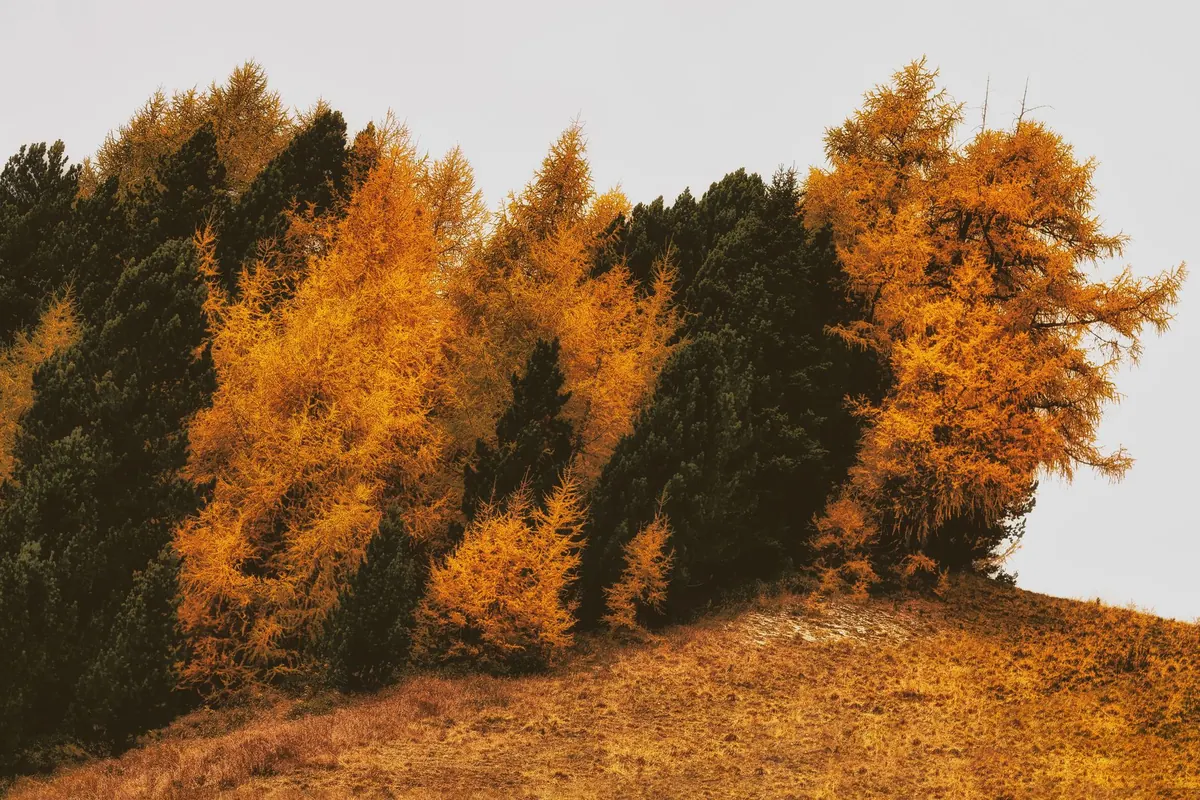
- Autumn. The needles turn golden yellow, sometimes with orange in it, and the whole tree glows. Larch is usually one of the first conifers to colour, and a stand of it against dark spruce is hard to miss. Then the needles fall, leaving the spurs behind.
- Winter. Bare. Look for the knobbly spurs, the fine twiggy crown, the grey fissured trunk and the small brown cones still clinging to the branches. Nothing else common in a British conifer plantation looks quite like this.
Telling larch from other UK conifers
- Scots pine: evergreen, with needles in pairs and orange-red bark high on the trunk. Never bare.
- Norway spruce and Sitka spruce: evergreen, with sharp needles set all round the shoot and cones that hang downwards.
- Douglas fir: evergreen, with soft needles that smell of citrus when crushed and cones that hang down with distinctive three-pointed bracts.
- Yew: evergreen, with flat dark needles and red fleshy arils instead of cones.
- Bare broadleaves in winter: check for cones and spurs. If the twigs feel pegged and there are small brown cones above, it is larch, not birch or alder.
One caution: larch in Britain has been badly affected by Phytophthora ramorum, a disease that causes rapid dieback and has led to felling in parts of the wetter west. If you are inspecting trees on your own land and see crowns thinning fast or dead tops on larch, take advice from a forestry professional or the relevant plant health authority before assuming it is just seasonal.
A five-minute larch check
Next time you are near a conifer, work through this in order. Look at the ground first — larch cones are small and often litter the path beneath the tree. Then look up: is the crown open and light, or dense and dark? Feel a twig if you can reach one. Soft needles in rosettes on woody spurs means larch; sharp needles all round the shoot means spruce. In winter, bare twigs with knobbly spurs and a few old cones still attached settle it. And if the tree is glowing gold in October while everything around it stays green, you have your answer before you even get close.