Larch rewards patience. Cut in winter, sawn straight and stacked with care, it dries into a tough, resinous timber that shrugs off weather outdoors and looks well indoors. It is also one of the more awkward softwoods to dry: the grain spirals, the boards move, and a British autumn will test any stack left open to the sky. Most warped, mouldy larch in a workshop was ruined in its first three months, long before it reached the bench.
What follows is the routine for air-drying and storing larch in a damp climate, from the moment the boards come off the mill to the day you bring them inside.
Why larch misbehaves
Larch grows fast and straight, but its grain often spirals gently up the trunk. As the board dries, that spiral pulls the timber into a twist, and no amount of weighting will take it out afterwards. Larch also shrinks noticeably across the width, more so than pine or spruce, so wide boards cup when one face dries faster than the other. Heartwood is reasonably durable and makes excellent cladding, fencing and outdoor joinery; the narrow pale sapwood is not, and it is the first part to stain and go mouldy.
None of this is unmanageable. It simply means the drying has to be even and slow rather than quick. Hot sun and a dry east wind are harder on larch than a mild, breezy fortnight.
Stacking for a British climate
Get the timber off the ground and into moving air fast, ideally within a week of sawing. A larch log left in the round over summer will be blue-stained and splitting before you get to it.
Site and foundation
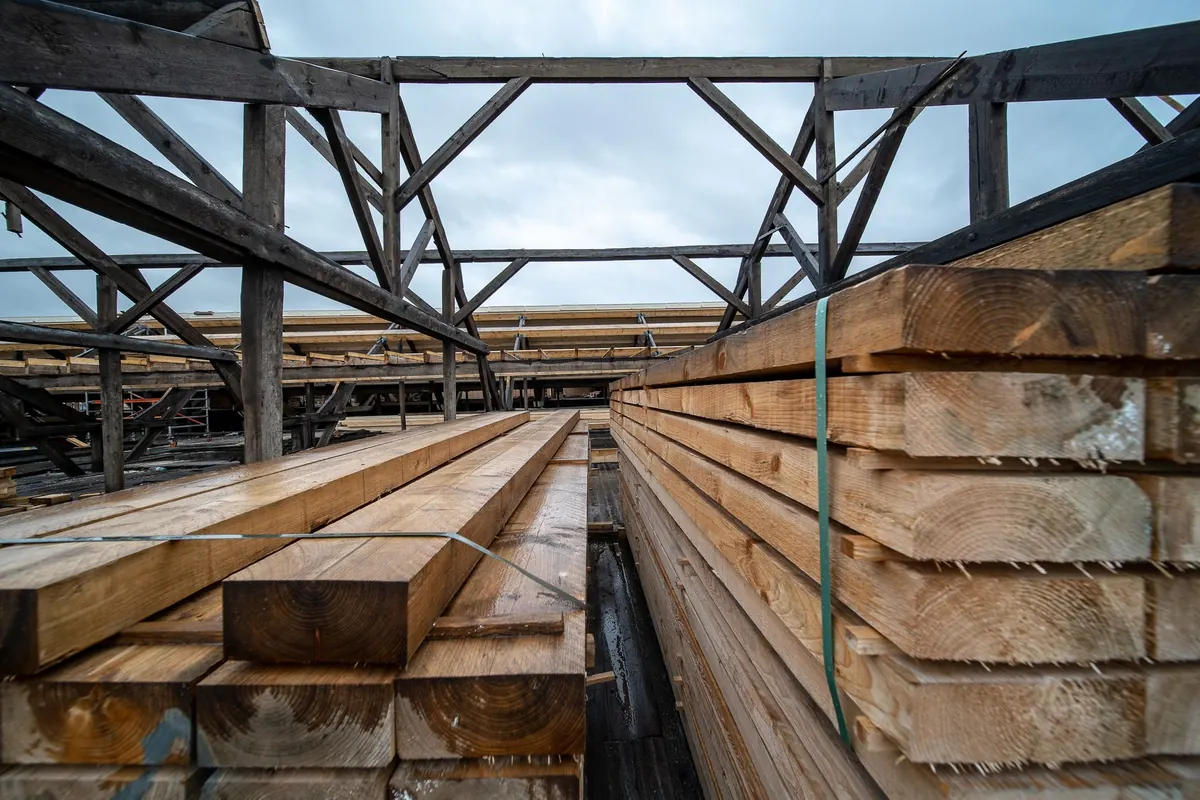
Choose an open spot where the prevailing wind blows across the stack, not a hollow where damp air settles and not under trees that drip. Rails, pallets or concrete blocks should lift the bottom layer 150–200mm clear of the ground, and they must be level — a stack that leans will lean for good once the timber stiffens. Grass, gravel and bare soil all push moisture back up, so a strip of membrane under the bearers helps.
Stickers, spacing and weight
Stickers, the dry spacers between layers, are what actually do the drying. Use dry timber roughly 20–25mm thick, and keep the following in mind:
- Sticker every 400–500mm along the length, lining each one up vertically with the one below so the load passes straight to the ground.
- Place the outermost stickers 50–75mm in from the board ends, where they hold the ends down and slow splitting.
- Leave 25–30mm gaps between boards in each layer. Tight stacking saves space and ruins timber.
- Put the best boards in the middle of the stack and the roughest on the outside, where they take the weather.
- Roof it with corrugated sheet or boards sloping backwards, overhanging the sides by 150mm but never resting on the top layer.
- Weight the roof with tyres or blocks, or strap the whole stack — larch lifts and shifts as it dries.
If you do only one thing, do this: get the timber off the ground, out of the rain and into moving air within a week of sawing it.
How long, and how dry?
The old rule of thumb is about 25mm of thickness per year of air drying. A 50mm board wants two years; a heavy 100mm beam wants four, plus a settling period. Time of year matters too: stack in spring and the first summer does most of the work, while a November stack sits wet until April.
Judge dryness properly rather than by feel. A cheap pin-type moisture meter reads the surface, which dries first and will lie to you. Push the pins into a freshly cut end, or split a test board and read the middle. For interior joinery in a heated house, aim for around 10–12 per cent; for sheltered outdoor work, 15–18 per cent is fine. Larch kept in an unheated shed will drift back up towards 16 per cent over a wet winter, which is why a final week indoors before machining is worth the wait.
Mould, blue stain and damp spells
Mould and blue stain need damp and still air, not rain alone. Blue stain is largely cosmetic: it discolours sapwood but does not seriously weaken it, though on a visible board it is the difference between a sale and firewood. Rot is another matter. Decay fungi generally need moisture content above about 20 per cent, so keeping the stack below that line is the whole game.
In mild, drizzly spells, watch the edges of the stack and the underside of the roof. An open-sided shelter, or simply a fan pointed along the stack, will see off most problems in a still corner of a yard.
Stop the ends splitting
End grain dries several times faster than the face, so the ends of larch boards check and split first. Two habits prevent most of it. Seal the ends of every board as soon as it is sawn — wax emulsion, gloss paint or a generous coat of PVA all work — and leave stock slightly over length, trimming the damaged 50mm off later once the timber has settled. Short offcuts and thin sections are the worst offenders, so process them or seal them rather than leaving them on the pile.
Moving it into the workshop
Bringing larch indoors is a step change, not a small one. Take it slowly:
- Move only the timber you plan to use within a few weeks; it will keep moving for a season or two.
- Acclimatise it in the room where the finished work will live, on stickers, for at least a week — longer for thick stock.
- Stack flat, supported at 400mm centres. Never lean boards against a wall or stand them on end.
- Machine oversize, then leave the components a day or two before final dimensioning.
- Keep the floor dry, and don't store larch directly on a cold concrete slab.
Larch resin is worth remembering at this stage. Warm, dry air coaxes pitch out of the wood, and it will gum planer blades and tables faster than you expect. Wipe the machine down and keep a scraper to hand.
The short version
Saw in winter if you can, seal the ends, get the stack off the ground within a week and build it with proper stickers under a roof that breathes. Dry it slowly, check the middle of a test board with a meter rather than trusting the surface, and keep it below 20 per cent moisture. Bring it indoors in small batches, let it settle for a week, and machine oversize.
Where a stack has to stand outside for years, accept that the outer boards are sacrificial and save them for rough work. Larch dried well is one of the most useful timbers in the workshop. Larch dried badly is firewood with a story.
Photo: art_of_pboesken / Pixabay